

Interior design space planning is one of the most critical yet often overlooked aspects of creating a functional and beautiful home. In Singapore, where living spaces are typically compact and highly valuable, effective space planning can significantly improve comfort, usability, and long-term liveability.
Whether you are moving into a new BTO flat, renovating a resale HDB, upgrading your condominium, or designing a landed property, thoughtful home space planning ensures every square foot works hard for your lifestyle.
At its core, interior space planning is about more than just furniture placement. It involves understanding movement flow, functional zoning, storage integration, lighting optimisation, and how each room connects with the next. This is the foundation of successful space planning and design.
This guide explores practical strategies used by our professional interior designers in Singapore in space planning projects to maximise efficiency, comfort, and style.
What Is Interior Design Space Planning?
Space planning is the process of organising a room's layout, deciding where furniture, zones, and circulation paths will sit in relation to one another and to the architecture of the space itself. It is not simply about fitting furniture in; it is about designing for how people actually live.
Space planning heavily influences your design outcomes. HDB flats, condominiums, and landed properties each present different challenges. A common issue among homeowners is misjudging proportions, resulting in furniture that overwhelms the room or layouts that hinder movement.
The distinction matters enormously in Singapore, where property sizes are constrained by urban density. A 4-room HDB flat typically offers between 90 to 105 square metres. A 2-bedroom condominium may be as compact as 65 square metres. Understanding your space constraints helps you plan your design effectively, from furniture choices to zoning and lighting.
Getting the space planning right from the outset saves you money, prevents costly mistakes during the build, and ensures your home functions beautifully for years to come.
Step One: Understand Your Property Type Before You Design
Singapore homes are not all the same, and the space-planning approach for each property type differs significantly. Before drawing up any plans or browsing inspiration boards, it is worth understanding the specific constraints and opportunities of your home.
BTO Flats are new builds with standard layouts and relatively straightforward wall configurations. The advantage is that you are starting with a clean slate; the limitation is that HDB regulations govern what can and cannot be modified. Wall hacking, electrical routing, and wet area extensions all require approval.
Resale HDB Flats often come with quirks, unusual room proportions, older plumbing positions, or dated layouts that no longer suit modern living. The payoff is that resale units tend to occupy more generous floor plates, particularly in older estates, and resale flats offer strong transformation potential for those willing to invest in thoughtful replanning. For ideas on what is possible, browse our HDB renovation ideas to see how others have transformed their spaces.
Condominiums operate under different rules from HDB, with greater flexibility for internal layout changes. However, many condominium units are smaller per square metre than comparable HDB flats, which means that with space at a premium, multifunctional design is essential; open-plan layouts, convertible furniture, and hidden storage solutions are being adopted to maximise every square metre. Exploring modern home interior design ideas can also help homeowners visualise layouts and aesthetics that effectively maximise compact condo spaces.
Landed homes present the most latitude for spatial creativity, including the potential to redesign across multiple storeys, add skylights, or create indoor-outdoor connections. The challenge here is ensuring spatial coherence across a larger footprint.
If you are renovating a landed property, our landed house interior design services at Homescape are designed to address exactly these complexities.
Step Two: Map Your Lifestyle Before You Map Your Layout
One of the most overlooked steps in any renovation is the lifestyle audit. Many homeowners jump straight into selecting tiles and carpentry finishes when the more important conversation is about how they actually live day to day.
A young family requires safe, practical layouts; a couple may want flexible workspaces; a multi-generational household may prioritise privacy and accessibility. Before you commit to ideas, ask yourself what purpose each room must fulfil.
Ask yourself the following before your first consultation:
- How many people live in this home, and what are their daily routines?
- Do any household members work from home regularly?
- How often do you entertain, and in what manner, sit-down dinners, casual gatherings, or both?
- Do you have young children or elderly parents whose mobility needs must be factored in?
- How much storage do you genuinely need, and where do you accumulate clutter most?
If you work from home, a well-designed workspace is essential. If you love entertaining, an open-plan living area might be ideal. Your budget determines the scope of your renovation. Prioritise essential upgrades first and add decorative elements later.
This lifestyle brief becomes the foundation upon which your space plan is built. A good interior designer will use this information to design zones and circulation paths that reflect your actual life, not a generic interpretation.
Step Three: Master the Principles of Space Planning
Once you understand your property and your lifestyle, you can begin applying the core principles of space planning.
Zoning: Dividing Space With Purpose
In smaller Singapore homes, rooms often serve multiple functions. The living room doubles as a workspace; the dining area moonlights as a homework zone. Zoning is the art of defining these functional areas within an open or semi-open layout without resorting to full walls.
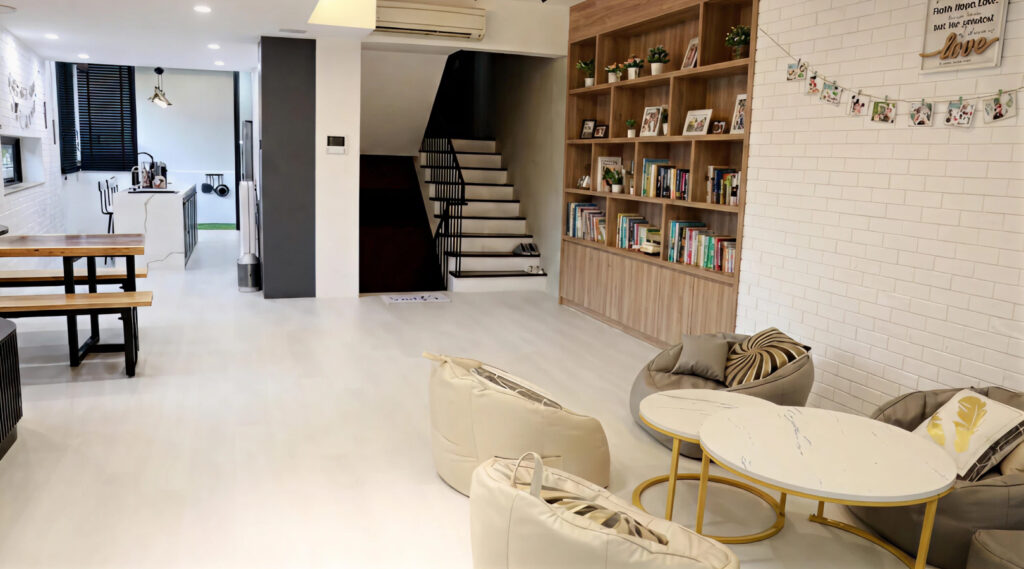
In open-concept HDB flats, defining spaces is crucial. Use area rugs, lighting, or furniture arrangements to create intimate zones, place a rug under your sofa and coffee table to anchor your living room, use pendant lights above the dining table to define the dining area, and set up a small reading nook with a comfy chair, a side table, and a lamp in a quiet corner. For inspiration on how this works in practice, take a look at our space-saving living room ideas to see clever zoning in real Singapore homes.
This approach gives each area a sense of identity while preserving the visual openness that makes compact homes feel larger.
Traffic Flow: The 900mm Rule
Traffic flow, the way people move through a space, is one of the most frequently neglected aspects of residential design. If your layout forces people to squeeze around furniture or navigate awkward corners, the home will feel uncomfortable regardless of how beautiful it looks.
Ensure a minimum 900mm of walking space between major furniture pieces. Follow the kitchen work triangle: sink, stove, and fridge within easy reach.
Apply this principle to every room. Between a bed and a wardrobe, between a dining table and a kitchen counter, between a sofa and a TV console, generous clearance transforms the daily experience of living in a space.
Vertical Space: Your Most Underused Asset
Singapore homeowners frequently focus on horizontal floor space while neglecting the walls and height above them. Vertical space isn't just for storage; it's also for decor. Floating shelves provide a platform for displaying photos and art without the bulk of a cabinet. By keeping the floor visible beneath your storage and display units, you trick the eye into perceiving the room as larger than it actually is.
Full-height cabinetry, wall-mounted shelving, and vertical gardens all exploit this principle to great effect. In bedrooms, consider floor-to-ceiling wardrobes with sliding doors rather than hinged panels, which eat into circulation space when open.
Lighting: The Space Planner's Secret Weapon
Spatial planning is not purely about furniture and walls; it encompasses light. The way a room is lit dramatically influences how large, warm, or comfortable it feels.
Plan lighting early, and combine ambient, task, and accent lights. Use warm lighting in living and bedroom spaces for comfort. Ensure sufficient power points in kitchens, study rooms, and near the TV console.
Natural light in particular should be factored into the layout from the start. Avoid placing tall furniture or floor-to-ceiling partitions in front of windows. Where direct sunlight is limited, add layered artificial lighting, recessed ceiling lights, pendant lights, and LED strips under cabinets, for depth and ambience.
Step Four: Storage, Plan for What You Have, and What You Will Accumulate
Storage is the perennial challenge in Singapore homes, and inadequate storage planning is one of the leading causes of renovation regret. Belongings tend to grow, not shrink. An expert interior designer knows how to unite open shelves, hidden storage, and multi-purpose furniture. Without this forethought, homeowners are left to play catch-up when they inevitably start to run out of space sooner than anticipated.
The most effective storage solutions in compact Singapore homes include:
- Integrated carpentry: cabinetry that is built into the architecture of the room rather than placed against it, reducing visual bulk.
- Multi-functional furniture: platform beds with drawers underneath, ottomans with internal compartments, bay window seats with lift-up storage.
- Hidden storage: concealed solutions such as full-height cabinets, flush carpentry, and hidden compartments keep surfaces clear without sacrificing functionality.
- Vertical storage towers in utility areas, corridors, and bedroom alcoves.
The key is to plan storage into the design from the beginning, not to retrofit it afterwards. Every corridor, alcove, and underutilised corner is an opportunity.
For homeowners renovating a resale HDB flat, our resale HDB interior design services include detailed storage planning as a core part of the design process.
Step Five: Avoid the Most Common Space Planning Mistakes
Even well-intentioned renovations go awry when certain pitfalls are overlooked. Here are the most common space planning mistakes Singapore homeowners make and how to avoid them.
Buying Furniture Before the Layout Is Finalised
It's easy to fall in love with a sofa online, but without scale planning from interior designers, it may overwhelm the room. Oversized pieces disrupt the flow of movement and block natural light. Before you purchase anything, read our guide on choosing the right home furniture. It will save you from costly decisions made too early. Always finalise your floor plan, confirm furniture dimensions against it, and leave adequate clearance before purchasing anything.
Prioritising Aesthetics Over Functionality
Successful home interior design in Singapore requires meticulous preparation because our compact living spaces demand every square metre to work harder. You cannot afford to waste space on poorly considered built-ins or awkwardly positioned furniture that seems fine on paper but creates bottlenecks in real life. Walk through your space multiple times, imagining how you will move through it daily. Consider traffic patterns, storage needs, and how different family members will use each area.
Over-Investing in Built-Ins
Custom carpentry is enormously useful in Singapore homes, but there is such a thing as too much of it. While custom carpentry maximises space, it can limit flexibility. Overbuilt designs may feel outdated quickly and reduce resale appeal. Mix built-ins with loose furniture and choose neutral carpentry finishes to ensure longevity.
Ignoring the Kitchen Work Triangle
The kitchen is one of the most spatially critical rooms in any home, and its layout directly affects daily quality of life. An inefficient kitchen, where the sink, hob, and refrigerator are poorly positioned relative to one another, creates friction every time you cook. Discuss kitchen space planning explicitly with your designer before any carpentry is committed.
Neglecting Future Needs
A home designed purely for today's household will feel inadequate in five years if your circumstances change. Plan for the family you may have, not just the one you have now. Build in flexibility where possible, a study that can become a nursery, a guest room that can serve as a home office.
Space Planning for Different Home Types: A Quick Reference
BTO Flats: Focus on open-plan living and dining to create a sense of visual spaciousness. Invest in built-in storage early. Plan lighting points before carpentry is installed. Consider whether the walls between bedrooms and living areas can be reconfigured to improve flow.
Resale HDB: Audit the existing layout critically. Identify walls that can be hacked (with HDB approval) to open up the floor plate. Pay particular attention to wet areas, kitchens and bathrooms, which often require modernisation alongside the redesign.
Condominiums: Prioritise multifunctional zones and convertible furniture. Think fold-down desks, built-in wardrobes, and modular seating that adapts to different needs throughout the day. For homeowners with condominiums in Singapore, our condo interior design and renovation services are tailored to maximise every square metre.
Landed Homes: Consider how circulation flows both vertically and horizontally. Define a clear spatial hierarchy, public entertaining spaces on the ground floor, private retreats above. Exploit ceiling height and the potential for skylights or double-volume voids to create drama and light.
When Should You Engage an Interior Designer for Space Planning?
The honest answer is: as early as possible. Many homeowners treat the interior designer as a finishing consultant, when in fact the most valuable thing a skilled designer does is spatial problem-solving.
Especially for homeowners with limited square footage, it's crucial to get layout planning right. Hiring an interior design consultancy firm makes a world of difference, as they can help map every centimetre to suit your actual lifestyle.
Engaging a renovation company in Singapore with in-house designers and contractors rather than coordinating between separate firms also ensures that the spatial plan translates seamlessly into the build. Design decisions that look elegant on paper sometimes require practical adjustments once construction begins; having both disciplines under one roof prevents miscommunication.
At Homescape, our design-and-build approach means your space plan is developed collaboratively with the same team that will execute it. This eliminates the friction that so often derails renovation projects and ensures that the home you envisioned is the home you move into.
Practical Space Planning Checklist for Singapore Homeowners
Before your first consultation or before you begin planning in earnest, work through the following:
- Have you measured every room accurately, including ceiling heights?
- Do you have a copy of your unit's floor plan from HDB or the developer?
- Have you listed the functions each room must serve, including secondary uses?
- Have you identified where natural light enters and at what times of day?
- Have you listed your storage needs by room?
- Do you know which walls are structural and cannot be removed?
- Have you considered how your needs might change in the next five to ten years?
- Have you established a realistic budget that includes a contingency of at least 10 to 15 per cent?
Effective space planning is not just about arranging furniture or maximising square footage. It requires a deep understanding of how people move, live, and interact within a space, combined with technical knowledge of structure, regulations, and buildability.
Conclusion
Good space planning is not a luxury reserved for large homes or big budgets. It is a discipline that pays dividends in every room, in every property type, and at every price point. The homes that feel most effortlessly liveable, whether a compact 3-room HDB flat or a spacious landed house, are almost always the result of careful, considered spatial thinking before a single nail was hammered.
Whether you are embarking on a BTO renovation, refreshing a resale flat, or planning a premium condominium redesign, Homescape's team of experienced interior designers and renovation specialists will work with you from initial space planning through to handover.
It's More Than Just Design.
At Homescape, we approach space planning as the foundation of every successful home. From interpreting floor plans to aligning layout decisions with real-life routines, our team ensures that each design is both practical and purpose-driven.
With an integrated design-and-build approach, we go beyond concepts to ensure that what is planned can be executed seamlessly on-site. The result is a home that not only looks considered on paper, but functions effortlessly in everyday living.
Ready to begin? Contact Homescape today for a personalised consultation and take the first step towards a home that works beautifully for the way you live.
FAQs
How much does interior design space planning cost in Singapore?
Space planning is typically included as part of a broader interior design engagement rather than charged as a standalone service. The cost of a full interior design and renovation package in Singapore varies widely depending on property type, size, and scope. For a 4-room HDB flat, full renovation packages from reputable firms typically range from $50,000 to $90,000 and above, depending on material choices and carpentry volume. It is always advisable to engage a firm that offers transparent, itemised quotations so you can see exactly what is included.
What is the minimum walkway clearance recommended in a Singapore home?
A minimum of 900mm is the standard recommended clearance for primary walkways, corridors, paths between sofas and coffee tables, and the main circulation routes through living and dining areas. In secondary spaces such as inside wardrobes or between a bed and a side wall, 600mm is generally considered acceptable. These measurements ensure comfortable movement without the home feeling cramped or obstructed.
How long does the space planning phase take before renovation begins?
The design and space planning phase typically spans four to eight weeks, depending on the complexity of the project and the number of revision rounds required. For larger projects such as landed homes or extensive resale HDB renovations, the design phase may extend further. This phase should not be rushed, the time invested in thorough space planning directly correlates with the smoothness of the subsequent build and the quality of the finished home.