


Renovating a landed property in Singapore is one of the most significant financial decisions a homeowner will make. Costs can range from S$80,000 for a light cosmetic refresh to well over S$2 million for a full reconstruction, and knowing where your project sits within that range before you commit is essential.
This guide breaks down the realistic cost of renovating every type of landed property in Singapore, explains what drives those costs, and helps you plan and budget with confidence. Whether you own a terrace house in Serangoon Gardens, a semi-detached in Bukit Timah, or a bungalow in the East Coast, the figures and frameworks here will give you a credible starting point.
At Homescape, we have been delivering landed property renovations in Singapore for more than 30 years. The cost ranges in this guide reflect real project data, current material and labour pricing, and our direct experience across all landed property types.
What Makes Landed Property Renovation Different From HDB or Condo Renovation?
Before diving into cost figures, it is worth understanding why landed property renovation is in a category of its own.
Unlike HDB flats or condominiums, a landed home means you own both the building and the land it sits on. This brings far greater design freedom, you can reconfigure layouts, extend floor areas, add storeys, create private pools, and transform the exterior, but it also brings far greater responsibility. There is no MCST or HDB managing shared infrastructure. Every structural, electrical, plumbing, and architectural decision falls on you.
Renovating a landed property involves more complex planning than HDBs or condos due to URA and BCA regulations, especially for structural works or rebuilding. This is why engaging an experienced landed property contractor in Singapore is crucial.
For landed homes, construction costs are also typically quoted on a per-square-foot basis. Industry estimates place landed renovation rates between S$300–S$700 per square foot, depending on complexity and materials. This is the starting framework for understanding how much to renovate landed property in Singapore. Now, let us go deeper into actual costs.
Landed Property Renovation Cost in Singapore: Quick Reference Table (2026)
The cost of landed property renovation in Singapore depends heavily on property type and scope.
| Property Type | Light Refresh | Full Renovation | A&A / Reconstruction |
| Terrace House | S$80,000 – S$150,000 | S$150,000 – S$350,000 | S$500,000 – S$1,000,000+ |
| Corner Terrace | S$100,000 – S$180,000 | S$180,000 – S$400,000 | S$600,000 – S$1,200,000+ |
| Semi-Detached | S$150,000 – S$250,000 | S$250,000 – S$500,000 | S$700,000 – S$1,500,000+ |
| Bungalow | S$250,000 – S$400,000 | S$400,000 – S$800,000 | S$1,000,000 – S$2,000,000+ |
| Good Class Bungalow | S$500,000+ | S$800,000 – S$1,700,000 | S$2,000,000 – S$5,000,000+ |
Construction costs for landed properties are typically quoted at S$300 to S$700 per square foot, depending on finish level and scope. Interior-only renovations may sit at the lower end; structural works and luxury finishes push into the upper range.
Landed Property Renovation Cost by Property Type
Terrace House Renovation Cost
Terrace houses are the most accessible form of landed living and, accordingly, the most affordable to renovate. They typically span two to three storeys and range from around 1,500 to 3,000 square feet of built-up area.
Renovating a terrace house in Singapore can range from S$50,000 to S$200,000, depending on scale and design preferences. However, a full interior overhaul, covering flooring, carpentry, bathrooms, kitchen, electrical, and ceiling works, typically lands in the S$150,000 to S$350,000 range for a standard inter-terrace.
For a corner terrace, expect to add a premium of roughly 15 to 25 per cent over an equivalent inter-terrace, given the additional façade exposure, side garden, and typically larger floor plate.
Typical terrace house renovation includes:
- Hacking of existing floors, tiles, and wet areas
- Full rewiring and electrical distribution board upgrade
- New plumbing throughout the kitchen and bathrooms
- Custom carpentry across all bedrooms and living spaces
- Kitchen redesign and installation
- Two to three bathroom renovations
- Flooring throughout all levels
- Painting, ceiling works, and feature wall treatments
- Air-conditioning installation or replacement
Semi-Detached House Renovation Cost
A semi-detached home occupies a minimum land area of 200 square metres and typically offers more generous internal proportions than a terrace, more bedrooms, larger common areas, and greater outdoor potential.
Full renovation costs for a semi-D typically range from S$250,000 to S$500,000, with structural works or significant A&A pushing costs above S$700,000. High-specification finishes with luxury materials, imported stone, premium bathrooms, bespoke joinery can bring a full renovation to S$600,000 to S$750,000 without touching the structure at all.
Semi-detached renovations often involve more extensive exterior work than terrace homes, including driveway resurfacing, landscaping, and façade treatment, which can meaningfully increase the overall cost.
Bungalow Renovation Cost
Semi-detached and bungalow renovations regularly exceed S$300,000, and full rebuilds or A&A works can go above S$600,000.
A standard bungalow outside a Good Class Bungalow area sits on a minimum plot of 400 square metres. The built-up area varies significantly, from around 2,500 to 6,000 square feet, and renovation costs reflect that range. A full interior renovation will commonly run from S$400,000 to S$800,000. Luxury finishes, complete structural reconfiguration, and the addition of a swimming pool can bring total costs well past S$1 million.
Good Class Bungalow Renovation Cost
Good Class Bungalows are in a category of their own. With a minimum land area of 1,400 square metres and built-up areas exceeding 10,000 square feet, even a conservative renovation requires a significant investment. Full GCB renovation projects, involving luxury material specifications, bespoke carpentry, smart home integration, pools, and landscaping, regularly exceed S$2 million and can reach S$5 million or more for ground-up rebuilds with ultra-premium finishes.
Types of Landed Property Renovation: Understanding Your Scope
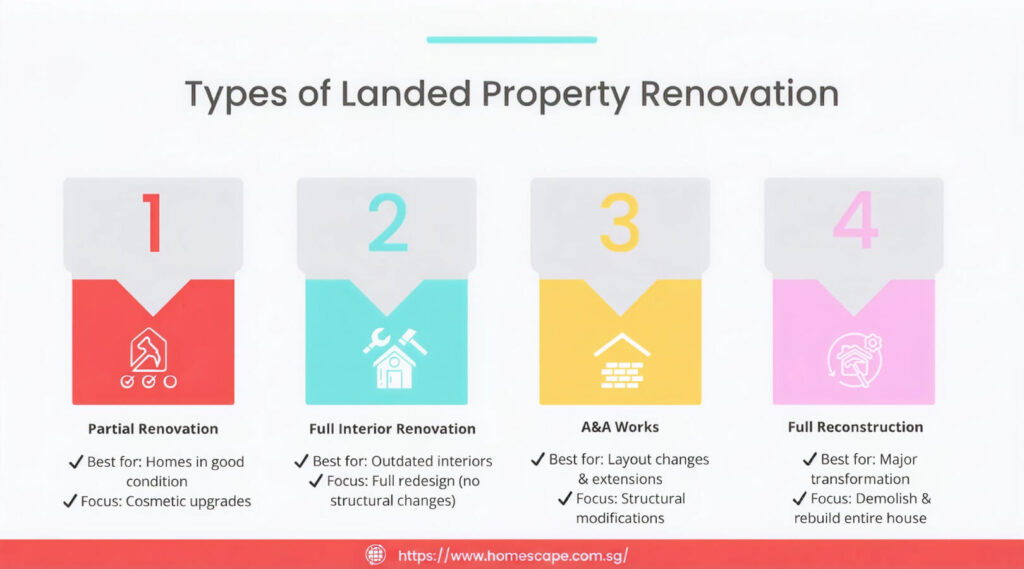
Not all landed property renovation projects are built the same. Whether you need a partial renovation, a full interior overhaul, or something more extensive like A&A or even reconstruction, significantly determines your timeline, cost, and scope.
1. Partial Renovation (Light Refresh)
A partial renovation refreshes specific areas without altering the structure or overall layout. This is appropriate when the property is in sound condition and requires targeted improvements.
What it typically covers:
- Repainting throughout
- Bathroom upgrades (fittings, tiles, sanitaryware)
- Kitchen refresh (new cabinet finishes, worktops, appliances)
- Flooring replacement in selected rooms
- New lighting and electrical points
- Air-conditioning replacement
Typical cost range: S$80,000 – S$180,000, depending on property size and material selections.
2. Full Interior Renovation
A full renovation involves a complete overhaul of the home's interiors, from hacking out old floors and tiles to redesigning every room. The structural envelope of the house remains unchanged, but everything inside is reimagined.
What it typically covers:
- Complete hacking and demolition of existing finishes
- Full replumbing and rewiring
- New flooring throughout all levels
- Complete carpentry wardrobes, kitchen cabinetry, and living room storage
- All bathrooms redesigned from scratch
- New ceilings, feature walls, and lighting design
- Air-conditioning full system replacement
- Landscaping and driveway works
Typical cost range: S$150,000 – S$800,000 depending on property type and finish level.
3. Alterations and Additions (A&A Works)
A&A works go beyond the interior to include structural modifications, reconfiguring internal walls, adding extensions, building additional floor area, or significantly altering the façade. These projects require professional submissions to the Building and Construction Authority (BCA) and, depending on the scope, the Urban Redevelopment Authority (URA).
Major structural works, including Alterations and Additions (A&A), cost S$200,000 to S$500,000 because they involve reconfiguring layouts, moving walls, and upgrading electrical, plumbing, and air-conditioning systems. For more extensive A&A works, costs can reach into the millions.
A Qualified Person (QP), a registered architect or structural engineer, is required for any A&A submission. Their fees, together with BCA and URA submission charges, add meaningfully to project costs.
4. Full Reconstruction (Rebuild)
When a property's structure is too dated, damaged, or simply incompatible with the homeowner's vision, a full demolition and rebuild may be the most practical choice. Luxury renovations or reconstruction exceed S$1 million and can top S$2 million when you rebuild the house with premium finishes, custom carpentry, and high-end smart systems.
Rebuilds also trigger stricter planning controls. Setback requirements, plot ratio rules, and height restrictions all apply. In some cases, land may need to be surrendered for road widening. A full rebuild typically takes 18 to 24 months from design to handover.
Key Factors That Affect Your Renovation Cost
1. Property Type and Size
The type of landed property in Singapore directly impacts renovation costs. The larger and more complex your property, the more you will spend. A 2,000-square-foot terrace costs materially less to renovate than a 5,000-square-foot bungalow, even at identical finish levels, simply because of scale. Every trade, flooring, ceiling, electrical, and carpentry charges by area or linear metre.
2. Condition and Age of the Property Type and Size
Resale properties frequently carry hidden costs that newly built or recently renovated homes do not. Resale properties usually cost 20% to 40% more because they often require hacking, rewiring, waterproofing, and plumbing upgrades before aesthetic work even begins.
Older landed homes particularly those built in the 1970s, 1980s, and 1990s, may have outdated single-phase electrical supplies, corroded cast-iron plumbing, compromised roofing, and in some cases, termite damage. Addressing these structural and infrastructure issues is not optional; it is the foundation upon which everything else is built.
3. Scope of Works
Whether you are doing a light cosmetic refresh or a full structural overhaul is probably the single largest determinant of cost. Define your scope with precision before approaching any contractor.
4. Finish Level: Basic, Mid-Range, or Luxury
Finish selections can swing your total budget by hundreds of thousands of dollars for the same scope of work.
Basic finishes: Standard ceramic or homogeneous tiles, laminate cabinetry, mass-market bathroom fittings, and mid-range light fixtures. Functional, durable, and cost-effective.
Mid-range finishes: Engineered timber or large-format porcelain tiles, semi-custom carpentry, quality bathroom brands such as Grohe or Hansgrohe, and layered lighting design.
Luxury finishes: Imported marble or natural stone, fully bespoke cabinetry, premium European bathroom brands, smart home integration, custom lighting concepts, and high-specification appliances throughout.
5. URA and BCA Approvals
Any renovation involving structural changes, façade alterations, additional floor area, or rooftop modifications will require regulatory approval. Professional fees for architects, structural engineers, and Qualified Persons combined with submission charges typically add S$20,000 to S$80,000 or more to the project cost, depending on the scope.
6. Contractor or Design-and-Build Firm
Working with an experienced landed property renovation specialist, particularly one offering an integrated design-and-build model, is not merely a matter of convenience. It directly affects your final cost. Firms with in-house design, project management, and construction teams eliminate the miscommunication and margin stacking that occur when multiple parties are involved. Experienced firms also foresee potential complications early, avoiding costly variations mid-project.
7. External Works
Landscaping, driveway resurfacing, fencing, roofing, external painting, and the installation of a swimming pool are often overlooked in initial estimates. For landed properties, external works can add S$30,000 to S$200,000 or more to the overall project, depending on the ambition of the brief.
Cost Breakdown by Renovation Component
To better understand where your budget is allocated, here is a typical breakdown across common renovation components:
Structural Works: S$50,000 – S$200,000+ Wall hacking and rebuilding, extensions, roofing adjustments
Carpentry: S$30,000 – S$120,000 Kitchen cabinetry, wardrobes, built-in storage
Flooring: S$20,000 – S$80,000 Tiles, vinyl, parquet, marble
Electrical and Plumbing: S$20,000 – S$60,000 Rewiring, lighting installation, water systems
Kitchen Renovation: S$20,000 – S$80,000 Cabinets, countertops, appliances
Bathroom Renovation: S$10,000 – S$30,000 per bathroom Sanitary fittings, waterproofing, tiling
Painting and Finishing: S$10,000 – S$30,000 Interior and exterior painting
All figures vary depending on property size and material specifications.
Additional Costs to Factor Into Your Budget
Professional Fees
For larger landed property projects, you may need:
- Architects
- Structural engineers
- Interior designers
Professional fees can range from 5% to 15% of the total renovation cost.
Permits and Approvals
Certain renovation works require approval from local authorities in Singapore, particularly for:
- Structural changes
- Extensions
- Drainage or utility modifications
Temporary Accommodation
If the renovation is extensive, you may need to budget for temporary housing during the renovation period.
Contingency Budget
It is advisable to set aside 10%–20% of your budget for unexpected costs, especially for older properties.
How to Budget Wisely for a Landed Property Renovation in Singapore
Set Clear Priorities
Identify what matters most:
- Space optimisation
- Aesthetic upgrades
- Long-term durability
Focus your budget on high-impact areas such as kitchens, living spaces, and bathrooms.
Avoid Over-Renovation
Spending excessively on luxury finishes may not always yield proportional value, especially if you plan to sell the property in the future.
Plan for Long-Term Value
Invest in:
- Quality materials
- Good workmanship
- Functional layouts
These factors improve durability and reduce maintenance costs over time.
When budgeting for a landed property renovation, it is important to account for both construction works and design-related expenses. Factors such as the scope of design services, custom-built furniture, material selections, and project complexity can all influence interior design costs in Singapore alongside the renovation budget itself.
Common Budget Mistakes to Avoid
- Underestimating the Condition of an Older Property: A resale landed home that appears to need only cosmetic work frequently conceals decades of wear and tear that must be addressed before renovation can begin. Always commission a thorough site inspection before finalising your budget.
- Not Budgeting for a Contingency: Set aside 10 to 15 per cent of your total renovation budget as contingency. For resale properties, lean toward 15 per cent. Unexpected structural issues, hidden plumbing deterioration, or material price fluctuations are common, especially in properties that have not been renovated in 10 to 20 years.
- Buying Furniture and Fittings Before the Layout Is Confirmed: It is natural to browse furniture while renovation planning is underway, but committing to purchases before floor plans are finalised is a common and expensive mistake. Pieces that work beautifully in a showroom can overwhelm a room or disrupt traffic flow once installed.
- Choosing a Contractor on Price Alone: Always request itemised quotes from at least two or three contractors. This helps you avoid hidden charges and ensures you understand exactly what you are paying for. A low headline price frequently conceals a narrowly scoped quotation that expands significantly through variation orders once work has commenced.
- Ignoring External Works in the Budget: Landed property renovation extends beyond the four walls of the home. Driveways, boundary fencing, roofing, landscaping, and exterior painting are often treated as afterthoughts, only to be discovered as a substantial additional cost. Include all external works in your initial budget planning.
- Adding Scope Mid-Project: Every change made after renovation has begun carries a premium. Decisions that cost S$2,000 before hacking may cost S$8,000 after the walls are already open. Finalise your brief thoroughly before work commences.
How to Choose the Right Landed Property Renovation Contractor in Singapore
Not all renovation firms are equipped to handle landed properties. The complexity of multi-storey homes, the regulatory requirements for A&A works, and the scale of project management required demand genuine expertise.
When evaluating firms, look for:
- A portfolio of completed landed projects. Ask to see before-and-after photography across terrace houses, semi-detached homes, and bungalows. Generic experience in HDB renovation does not translate directly to landed work.
- An integrated design-and-build model. Firms that employ both designers and contractors in-house avoid the communication breakdown that so frequently causes delays and cost overruns in multi-party arrangements. At Homescape, every project is managed by a single team from concept through to handover.
- Transparent, itemised pricing. Avoid firms that provide lump-sum quotations without line-item breakdowns. You cannot make informed decisions or compare quotes meaningfully without understanding what each cost element represents.
- BCA registration and relevant licences. For any structural works, your contractor must hold the appropriate BCA contractor registration. Verify this before signing anything.
- Realistic timelines with milestones. Experienced contractors provide phased schedules with defined payment milestones aligned to progress. If a firm cannot provide a detailed timeline, treat that as a warning sign.
- Post-renovation warranty. Quality firms stand behind their work. At Homescape, all renovation works are backed by a 12-month workmanship warranty, with a lifetime warranty on all cabinetry hardware.
Conclusion
Renovating a landed property in Singapore is a major undertaking that demands careful planning, realistic budgeting, and the right expertise. Costs range from S$80,000 for a light refresh to well over S$2 million for large-scale reconstruction with premium finishes, but with a clear scope, a credible budget, and the right team behind you, the process becomes far more manageable.
It's More Than Just Design.
With over 30 years of experience, Homescape's renovation contractors in Singapore take a structured approach to every landed renovation. From defining scope and aligning budgets to managing regulatory approvals and construction, our team ensures that every stage of the project is carefully planned and professionally executed.
With our integrated design-and-build model, we go beyond estimates and concepts to deliver outcomes that are realistic, controlled, and built to last. The result is not just a completed renovation, but a home that reflects thoughtful planning, quality craftsmanship, and long-term value.
Get in touch with Homescape today to start planning your landed property transformation.
FAQs
How long does a landed property renovation take in Singapore?
Timelines range from three months for a light refresh to two years for a full reconstruction. A comprehensive full interior renovation typically takes six to ten months. Structural or A&A work adds time to design development, professional submissions, and regulatory approval before construction can begin.
What is the difference between A&A works and full reconstruction?
Alterations and Additions (A&A) works involve structural modifications to an existing building, extending, reconfiguring, or adding floor area while the original structure largely remains. Full reconstruction involves demolishing the existing building entirely and rebuilding from the ground up. A&A works are generally faster and less costly, but may not be appropriate for severely dated or structurally compromised properties.
Is it worth renovating a landed property before selling in Singapore?
Strategic renovation can meaningfully increase a landed property's resale value. Kitchen and bathroom upgrades, fresh external paintwork, and landscaping improvements tend to deliver the strongest returns. However, a full luxury renovation is rarely recouped at the point of sale. Renovation for resale purposes should focus on broad appeal rather than highly personalised choices.
How much contingency should I set aside for a renovation of a landed property?
Set aside 10 to 15 per cent of your total renovation budget as contingency. For resale properties, particularly older homes, lean towards 15 per cent. Unexpected structural issues, hidden plumbing deterioration, and material price fluctuations are common in homes that have not been renovated in the last 10 to 20 years.